Currencies and cross rates (FXC)
FXC is a matrix of exchange rates between the major currencies, each cell saying how many units of the column currency one unit of the row currency buys.
- 3 min
- 3 questions
- Lesson 4 of 4
Why you would care
What is one currency worth in another right now? A US company selling in Europe earns less in dollars when the euro falls. A European investor in US stocks gains or loses on the dollar as well as on the stock. Currency moves sit inside every international number, and the FX market is the largest market in the world.
The idea from scratch
An exchange rate is the price of one currency in another. Currency pairs are written base/quote: EUR/USD = 1.1374 means one euro (base) costs 1.1374 dollars (quote).
- If EUR/USD rises, the euro strengthens (appreciates) and the dollar weakens.
- Some pairs are quoted the other way by convention: USD/JPY = 158.41 means one dollar buys 158.41 yen.
A cross rate is a rate between two non-dollar currencies, computed through the dollar:
What moves currencies (chapter 01, The macro machine and chapter 08):
- Interest rate differentials: higher rates attract money.
- Growth and inflation: strong growth supports a currency; high inflation erodes it.
- Risk appetite: in panics, money runs to the dollar, the yen and the Swiss franc ("safe havens").
- Trade flows and capital flows.

See it in Gloom
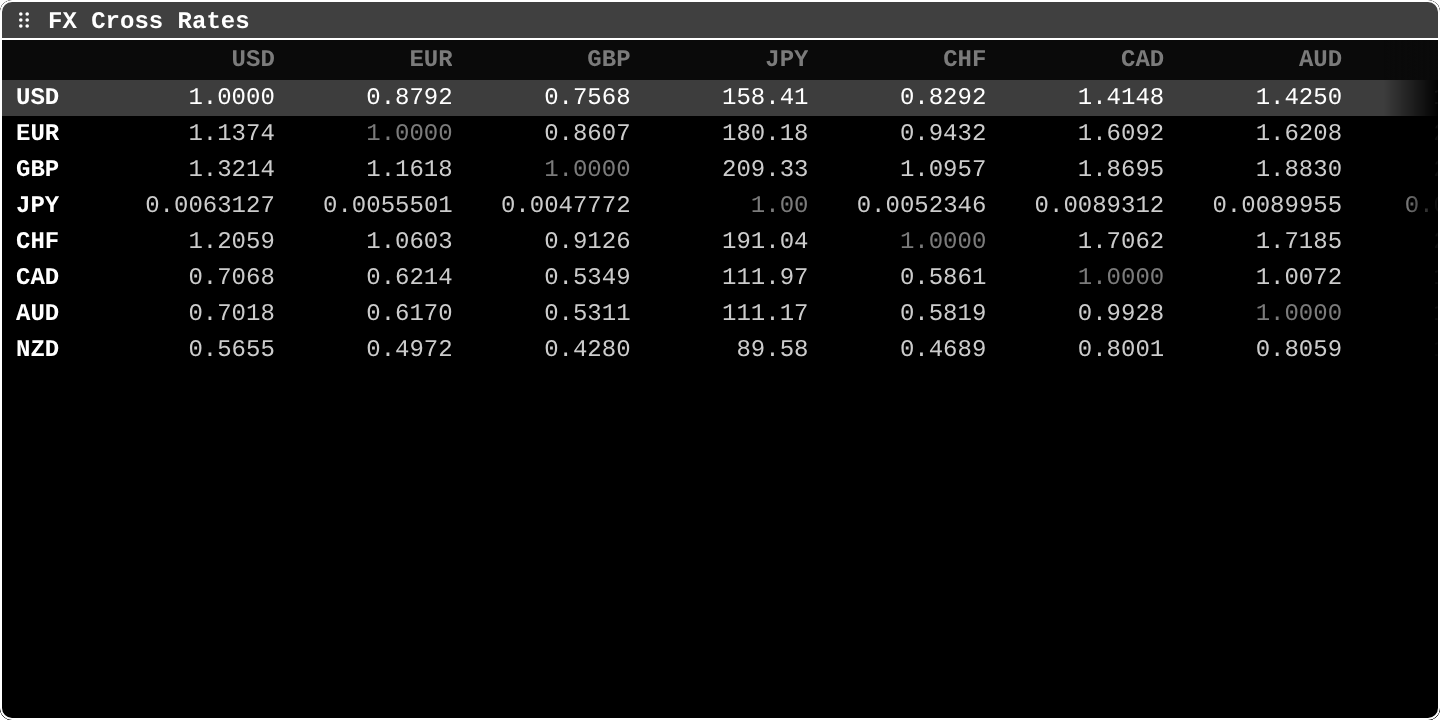
open ittype FXC. It also sits in the FX & macro desk.
- Row
USD: one dollar buys0.8792euros,0.7568pounds,158.41yen,0.8292Swiss francs. - Row
EUR: one euro buys1.1374dollars (that is EUR/USD),0.8607pounds (EUR/GBP),180.18yen. - The diagonal is
1.0000: a currency in itself. - Each cell is the inverse of its mirror: USD→EUR 0.8792 and EUR→USD 1.1374 multiply to about 1.
- Row
JPY: tiny numbers because one yen is worth less than a cent.
Practice and recap
Try it3 tasks
- From the matrix, how many yen does one pound buy? (209.33.)
- Check a cross: EUR/USD 1.1374 / GBP/USD 1.3214 ≈ ? (0.861, matching EUR→GBP 0.8607.)
- US rates rise while European rates fall. Which way would EUR/USD tend to move? (Down: the dollar tends to strengthen.)
Common mistakes4 mistakes
- Reading the pair the wrong way round (USD/JPY vs JPY/USD).
- Forgetting that a strong home currency lowers the value of foreign earnings.
- Treating FX moves as small: a 10% currency move can erase a year of stock gains for a foreign investor.
- Ignoring that rates and FX are linked.
Check yourself3 questions
- What does EUR/USD 1.10 mean?
- What is a cross rate?
- Name two safe-haven currencies.
Answers
- One euro costs 1.10 US dollars.
- An exchange rate between two non-dollar currencies, usually computed through the dollar.
- Any two of the US dollar, the Japanese yen, the Swiss franc.
Words in this lesson5 words
- exchange rate
- The price of one currency in another.
- base / quote currency
- The first / second currency in a pair.
- appreciate / depreciate
- A currency gaining / losing value.
- cross rate
- A rate between two non-dollar currencies.
- safe haven
- A currency investors buy in panics.
Educational material about reading market data, not investment advice.