The earnings calendar and implied moves (ERN, EVTS)
EVTS lists who reports this week with the move options are pricing and the move the stock usually makes, and ERN <ticker> shows one company's next report and its history.
- 5 min
- 3 questions
- Lesson 1 of 5
Why you would care
Who reports when, and how big a move does the market expect? In earnings season, thousands of companies report in a few weeks. A holding can jump 10% overnight. Knowing the date, the time and the size of the move the market expects is the minimum before you hold a stock through a report.
The idea from scratch
The report day
Each quarter a company publishes its results on a date it announces in advance (chapter 01, How information reaches prices). The time matters:
BMO
before the market opens.
DMH
during market hours.
AMC
after the market closes.
An AMC report moves the stock in after-hours trading, and the first regular-session reaction is the next day.
The implied move: what options are pricing
An option is a contract that pays if the stock moves (chapter 06). Before a report, traders pay more for options because a big move is coming.
A straddle is a call plus a put at the same strike, near the current price. It pays off if the stock moves a lot in either direction. Its price, divided by the stock price, is the implied move: roughly how big a move, up or down, the option market expects.
The realized move
After the report, the realized move is what actually happened: from the close before the report to the first close after it. The average move is the average size (up or down) of the last eight reports.
Comparing the two tells you whether options are pricing a bigger or smaller move than usual.
- Report date and time
- Before: implied move from the straddle
- Report: result vs consensus
- After: realized move
- Compare realized vs implied, and vs the average move
See it in Gloom
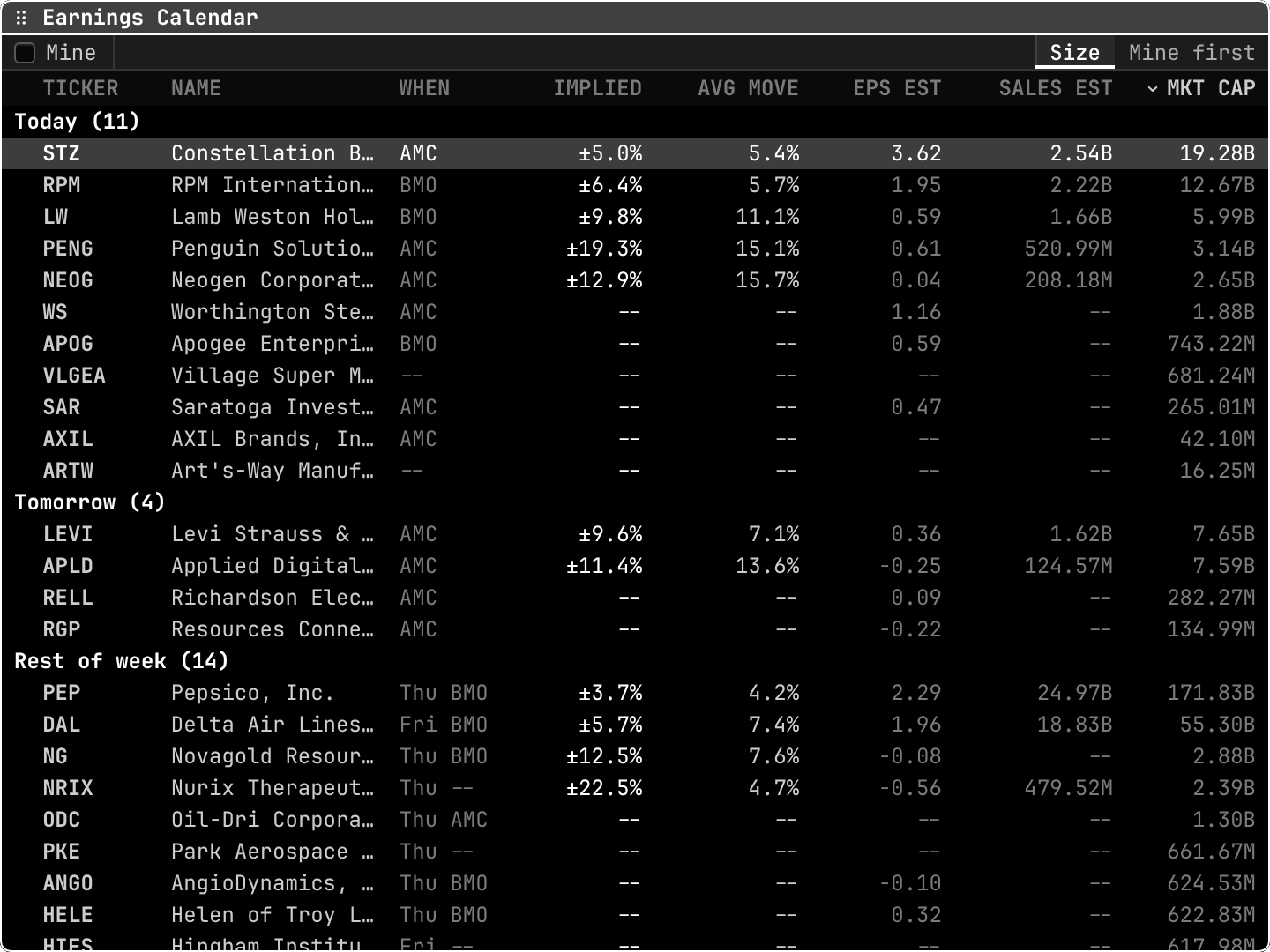
open ittype EVTS for the market board, or ERN NVDA for one company's history. Keys: t ticker, e estimates, c calls, a analysts.
- Groups:
Today (11),Tomorrow (4),Rest of week (14), largest companies first. STZ Constellation B… AMC ±5.0% 5.4%: reports after the close; options price about ±5.0%; its last reports moved 5.4% on average.LW ... BMO ±9.8% 11.1%: a bigger expected move, and a history of big moves.EPS ESTandSALES EST: the consensus for the quarter (APLD -0.25: a loss expected).--: no options priced, or no estimate. Small companies often have none.MineandMine first: show only, or first, the names in your portfolio and watchlists.
ERN <ticker> adds the history: each past report with its implied move, realized move and VS IMPL, the realized move divided by the implied one (above 1x, the stock moved more than options priced).
Practice and recap
Try it3 tasks
- In the screenshot, which company today has the largest implied move? (PENG, ±19.3%.)
- For PEP, is the implied move above or below its average move? (Below: ±3.7% vs 4.2%.)
- A stock at 50 has a straddle costing 4. What is the implied move? (8%.)
Common mistakes4 mistakes
- Reading the implied move as a forecast of direction. It is size only, up or down.
- Forgetting the time: an AMC report is not "today" for the regular session.
- Comparing implied and realized moves on different expiries; when the first expiry is weeks away, the straddle also prices those weeks, so it overstates the event.
- Assuming small companies have no news risk because the columns are empty.
Check yourself3 questions
- What is a straddle?
- What does
VS IMPL 1.5xmean? - What does DMH mean?
Answers
- A call plus a put at the same strike; it gains on a big move in either direction.
- The stock moved one and a half times the move options had priced.
- During market hours.
Words in this lesson5 words
- BMO / DMH / AMC
- Before the open / during market hours / after the close.
- straddle
- A call plus a put at the same strike.
- implied move
- The straddle's price over the stock price: the expected size of the move.
- realized move
- The actual move from the close before the report to the first close after.
- average move
- The average size of the last eight report moves.
Educational material about reading market data, not investment advice.