Credit spreads (CRD)
A credit spread is the extra yield a company pays over a government bond for the risk of not paying back, and CRD shows the spreads of US corporate bond indices by rating.
- 4 min
- 3 questions
- Lesson 1 of 3
Why you would care
How nervous are lenders about companies? Credit markets often sense trouble before stock markets: when spreads widen fast, lenders are getting nervous about the economy. Spreads also set what companies pay to borrow, which feeds into their profits, buybacks and deals.
The idea from scratch
From chapter 01, Bonds in one page: a company bond yields more than a government bond of the same maturity. The difference is the credit spread, in basis points.
Ratings and buckets
Rating agencies grade borrowers. The ladder (one agency's style): AAA, AA, A, BBB (all investment grade, IG), then BB, B, CCC and below (high yield, HY, or "junk"). The lower the rating, the wider the spread.
| Bucket | Typical spread level (illustrative) | Plain meaning |
|---|---|---|
| AAA | Tens of bp | Very safe borrowers |
| BBB | Around 100 bp | The lowest investment grade |
| HY | Several hundred bp | Real chance of default |
What moves spreads
Default risk
weaker economy, more defaults expected, wider spreads.
Liquidity and risk appetite
in a panic, investors sell anything risky and spreads widen even for safe names.
Supply
a wave of new bonds can widen spreads.
Option-adjusted spread (OAS): many corporate bonds can be repaid early by the issuer (callable); the OAS removes the value of that option so bonds compare fairly. Index spreads are usually quoted as OAS.

See it in Gloom
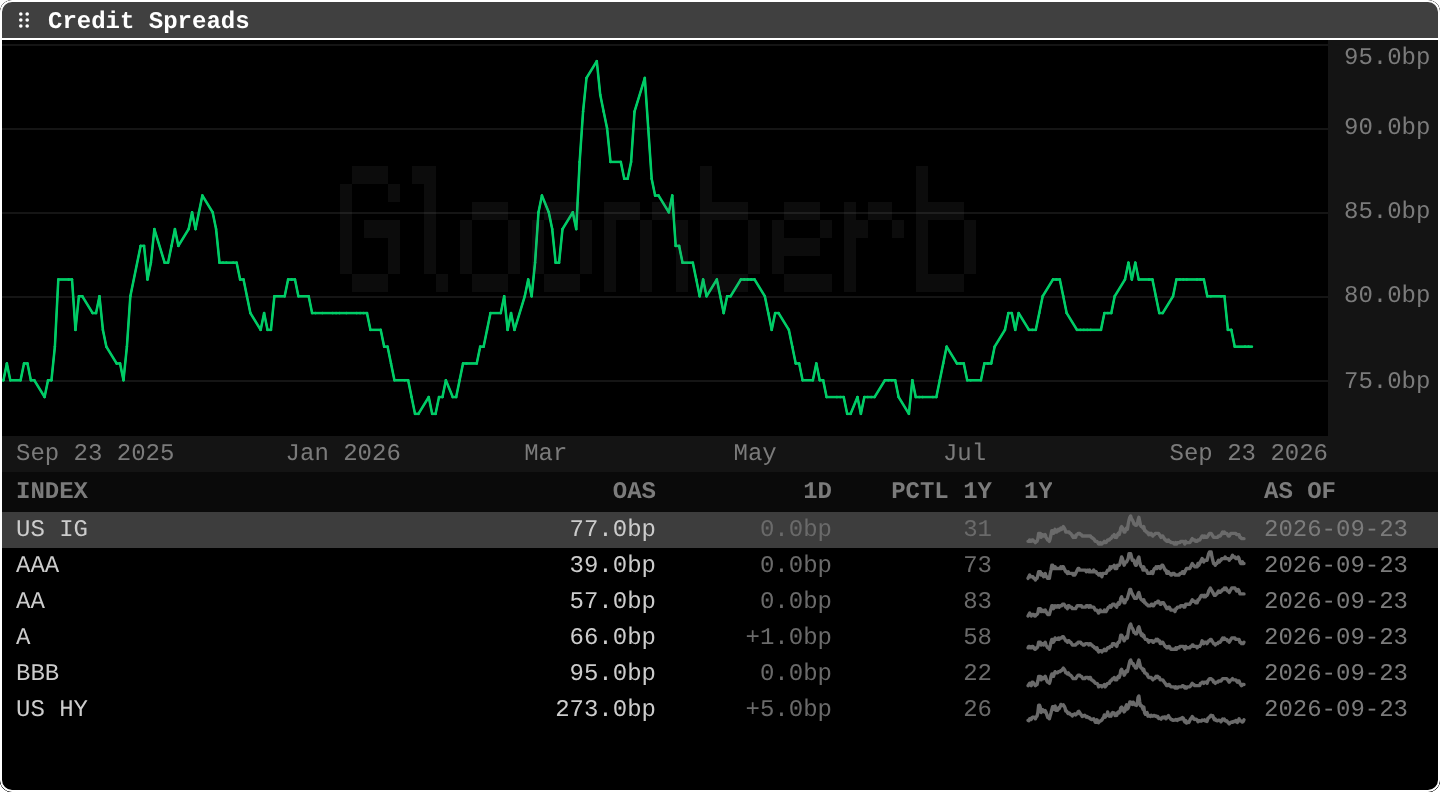
open ittype CRD. Select a row to chart it.
US IG 77.0bp PCTL 1Y 31: investment-grade companies pay 77 bp over Treasuries, lower than on 69% of the past year's days.- The chart: a spike to about 95 bp in March 2026 (a risk-off episode), then back to the 70s and 80s.
AAA 39.0bp,AA 57.0bp,A 66.0bp,BBB 95.0bp: the ladder widens as quality falls.US HY 273.0bp +5.0bp: high yield pays far more and moved most on the day.AS OF 2026-09-23: daily close, published the next day.
Practice and recap
Try it3 tasks
- How much more does a BBB company pay than an AAA company, in the screenshot? (95 - 39 = 56 bp.)
- Treasury 5.00%, HY spread 273 bp: rough HY yield? (About 7.73%.)
- Spreads widen 50 bp in a week while Treasury yields fall. What is the market saying? (Fear: money flees to safe government bonds while demanding more from risky borrowers.)
Common mistakes4 mistakes
- Comparing a spread with a yield.
- Reading tight spreads as "safe forever": spreads can gap wider fast.
- Mixing index spreads with one company's bond spread.
- Forgetting that ratings change: fallen angels (IG cut to HY) often see big spread jumps.
Check yourself3 questions
- What is a credit spread?
- Which ratings are investment grade?
- What does OAS adjust for?
Answers
- The extra yield a borrower pays over a government bond of the same maturity.
- AAA, AA, A and BBB (down to BBB-).
- The value of embedded options, such as the issuer's right to repay early.
Words in this lesson6 words
- investment grade (IG)
- Rated BBB- or better.
- high yield (HY)
- Rated below BBB-.
- option-adjusted spread (OAS)
- A spread with embedded options' value removed.
- callable bond
- A bond the issuer may repay early.
- fallen angel
- A bond cut from investment grade to high yield.
- widening / tightening
- Spreads rising / falling.
Educational material about reading market data, not investment advice.