Hiring signals (JOBS, HIRE)
JOBS reads one company's open roles over time from its own careers site, and HIRE compares hiring momentum across companies.
- 4 min
- 3 questions
- Lesson 4 of 8
Why you would care
Where is this company hiring, and is it speeding up or slowing down? Hiring is a leading indicator: a company builds teams before it launches products or enters markets, and freezes hiring before it cuts costs. A surge in AI roles, a new office abroad, or a sudden halt in postings can show strategy months before an earnings call. It is one of the classic "alternative data" signals used by hedge funds.
The idea from scratch
An open role (requisition) is a job posting on a company's careers site. Counting them over time gives:
Open roles
how many postings are live.
Additions / removals
new postings and closed ones each week.
Net change
additions minus removals.
Mix
by function (engineering, sales, finance...), location, seniority, topic (AI, robotics...).
Limits:
- Open roles are not hires, employees or headcount.
- A closed posting may be filled, cancelled or just reposted.
- Coverage depends on the careers systems that can be read.
A z-score of the weekly change (how unusual it is against the company's own past) flags surges and freezes.

See it in Gloom
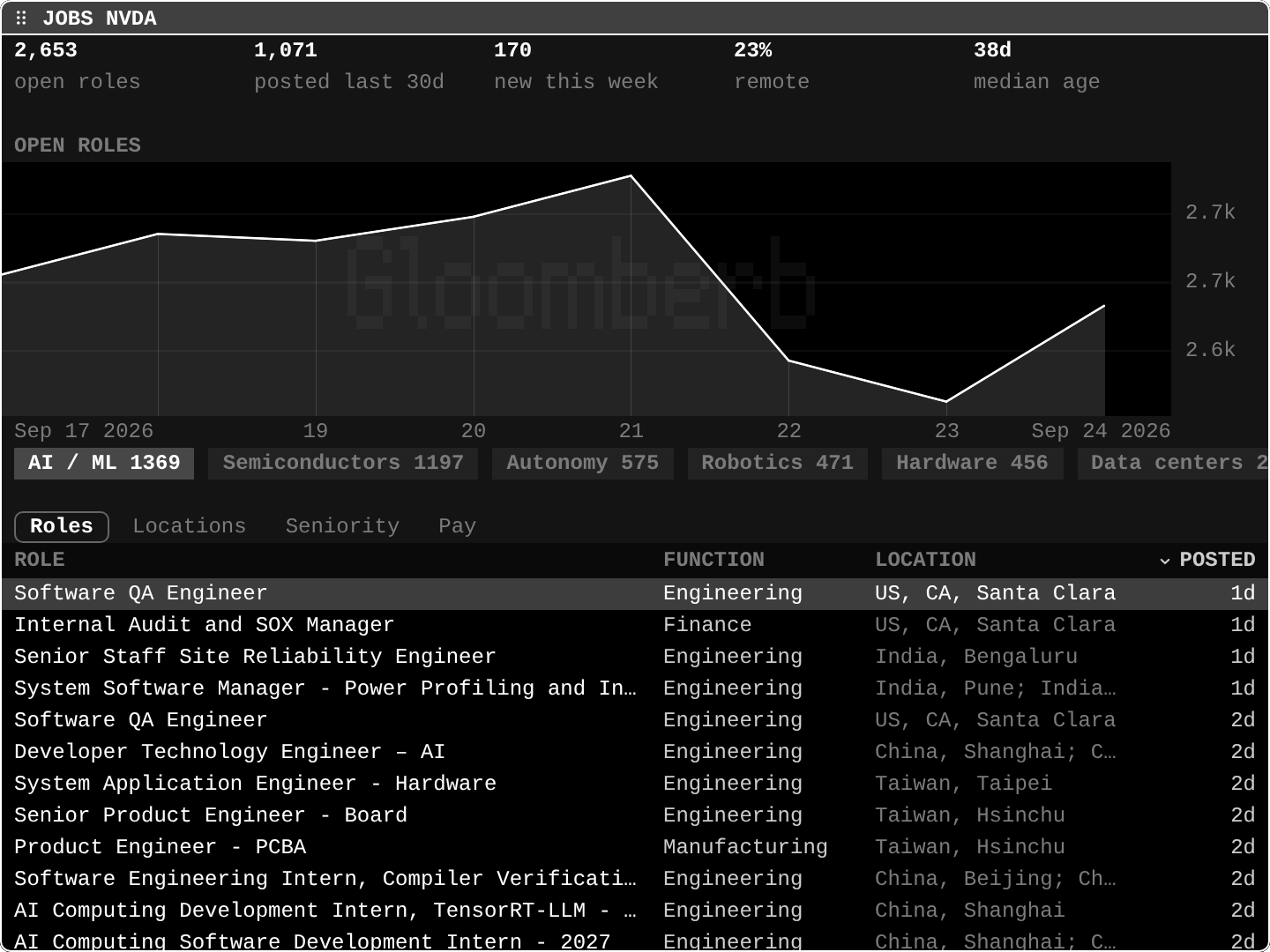
open themJOBS NVDA for one company; HIRE for the board across covered companies, HIRE NVDA for one. Tabs in JOBS: Roles, Locations, Seniority, Pay.
2,653 open roles,1,071 posted last 30d,170 new this week,23% remote,38d median age.- The chart: open roles peaked on Sep 21 and dropped on Sep 22 to 23, then recovered.
- Topic chips:
AI / ML 1369,Semiconductors 1197,Autonomy 575,Robotics 471,Data centers: where the company is hiring. - The list: role, function, location, posting age (
1d). - Locations such as Taiwan, China and India: where engineering capacity is being built.
HIRE adds weekly additions, removals, net change and z-scores, signals read in tone (a surge green, a freeze red), role-family mix and peers.
Practice and recap
Try it3 tasks
- What share of NVIDIA's open roles in the chips mention AI / ML? (1,369 of 2,653: about half.)
- Why is "170 new this week" more informative than total open roles? (It shows current activity, not old postings still open.)
- Open roles fall 10% in a week. Name two explanations other than a freeze. (A batch of roles filled or closed at once; postings moved to another careers site.)
Common mistakes4 mistakes
- Reading open roles as headcount.
- Over-reacting to one week's change.
- Comparing companies with very different posting habits.
- Ignoring location and function shifts, often the most useful part.
Check yourself3 questions
- What is an open role?
- What does net change mean?
- Name one limit of hiring data.
Answers
- A job posting live on a company's careers site.
- New postings minus removed postings over the period.
- Any one: postings are not hires; closed postings may be cancelled or reposted; coverage depends on readable careers systems.
Words in this lesson5 words
- alternative data
- Non-financial data that hints at business activity.
- open role (requisition)
- A live job posting.
- additions / removals
- New / closed postings in a period.
- hiring freeze
- A pause in new hiring.
- mix
- The split by function, location, seniority or topic.
Educational material about reading market data, not investment advice.