Catalysts (CATL)
CATL is a calendar of dated events that can move a stock (trial results, regulators' decisions, court deadlines, tariffs), each with its date basis, status and source.
- 4 min
- 3 questions
- Lesson 2 of 3
Why you would care
A biotech company can double or halve on one trial readout. A chip maker can drop on a new export rule. These dates are often known months ahead, buried in public records.
CATLbrings them into one calendar, with evidence you can open.
The idea from scratch
Think of a stock's future as a road with known bumps:
Clinical
a drug trial finishes or reports; a regulator (the FDA in the US, the EMA in Europe) decides on approval.
Regulatory and competition
an antitrust review of a merger, a new rule, a deadline for comments.
Legal
a court date, a settlement deadline, an enforcement action.
Trade policy
tariffs, sanctions, export controls taking effect.
Each date has a basis, a reason it exists, and the basis tells you how firm it is:
- Announced
- When something was made public
- Effective
- When a rule or decision starts to apply
- Deadline
- A due date set by a regulator or court
- Completion
- When a clinical study is expected to finish (an estimate that often moves)
Dates move. A study's expected completion can slip by a year. That is why the history of revisions (each observed change) is as useful as the date itself.

See it in Gloom
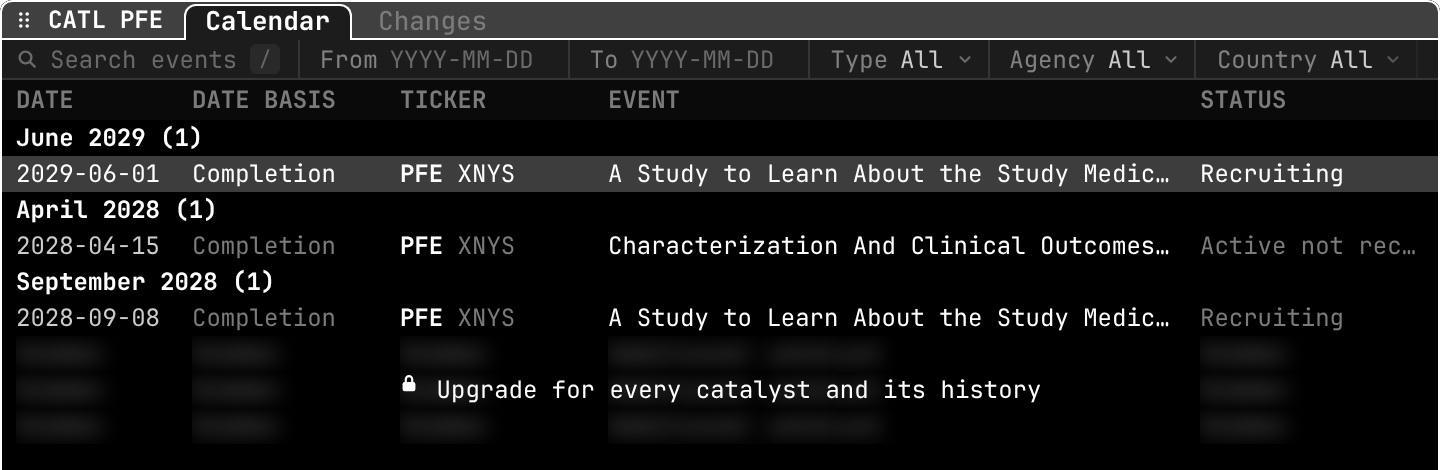
open ittype CATL for the whole market or CATL PFE for one company. Tabs: Calendar and Changes (revisions as they are observed).
- Filters on top: search, a date window (From, To), Type, Agency, Country.
2029-06-01 Completion PFE XNYS: an expected study completion date for a Pfizer study, listed on the NYSE (XNYS).EVENT: the study's title, cut short;Enteropens the evidence, the original quote and the history of revisions.STATUS:Recruiting(still enrolling patients),Active not recruiting(running, no new patients).- The lock: free accounts see three events with their evidence; Pro sees every event and its history.
- Read the dates, not the order: in this preview the months are not sorted by date.
Keys: o opens the primary document, a creates an alert on new events or changes (Pro), d opens the company's overview.
Practice and recap
Try it3 tasks
- In the screenshot, which event is the earliest? (2028-04-15, the study that is active and no longer recruiting.)
- Why is a "Completion" date weaker than a "Deadline"? (It is the sponsor's estimate and can move; a deadline is set by a regulator or court.)
- Name one catalyst type that could hit a chip maker. (An export-control rule or a tariff.)
Common mistakes4 mistakes
- Treating an expected completion date as a result date. Results often come months later.
- Assuming a linked event is material. A giant company has hundreds of small events.
- Forgetting jurisdiction: the country is where the event happens, not where the company is based.
- Reading "no events" as "no risk".
Check yourself3 questions
- What is a catalyst?
- What does the date basis tell you?
- Why are revisions worth watching?
Answers
- A dated event that can move a stock's price.
- Why the date exists (announced, effective, deadline, completion) and so how firm it is.
- Because a date moving (a delay, a new deadline) is often news in itself.
Words in this lesson7 words
- catalyst
- A dated event that can move a price.
- date basis
- Why a date exists: announced, effective, deadline, completion.
- clinical trial
- A study testing a drug or device in people.
- FDA / EMA
- The US / European medicines regulators.
- antitrust
- Rules against monopolies and harmful mergers.
- export control
- A government limit on selling certain goods abroad.
- revision
- An observed change to an event's date or details.
Educational material about reading market data, not investment advice.