What an option is (calls and puts)
An option is the right, but not the duty, to buy or sell something at a fixed price before a deadline, and you pay a fee for that right.
- 5 min
- 3 questions
- Lesson 1 of 5
Why you would care
You hear a trader say "I bought the NVDA 250 calls for October". Or "the vol desk is short gamma". None of it makes sense until you have one simple picture of what an option is.
Once you have it, the rest of this chapter is just detail on that picture.
The idea from scratch
A call is a deposit on a house
You like a house that costs $500,000. You are not sure yet. So you pay the owner $5,000 today for the right to buy it at $500,000 at any time in the next 3 months.
- The house rises to $600,000: you buy at $500,000. You gain $100,000 minus your $5,000 fee.
- The house falls to $450,000: you walk away. You lose only the $5,000.
That is a call option: the right to buy at a fixed price.
A put is insurance
You pay a car insurer a yearly fee. In return you have the right to be paid an agreed amount if your car is wrecked. If nothing happens, the fee is gone and you are fine with that.
That is a put option: the right to sell at a fixed price. People use puts to protect a stock they own.
The same picture in market words
| House story | Option word | Plain meaning |
|---|---|---|
| The house | underlying | The thing the option is about (a stock, an ETF, an index) |
| $500,000 | strike | The fixed price you may buy or sell at |
| 3 months | expiry | The deadline. After it the option is worthless |
| $5,000 | premium | The price of the option, paid up front |
| You | buyer ("long") | Pays the premium, has the right |
| The owner | seller ("writer", "short") | Gets the premium, must deliver if the buyer uses the right |
Using the right is called exercising. Most traders never exercise: they sell the option before expiry instead.

Real numbers
Listed options are standard: one contract covers 100 shares. Prices are quoted per share.
Illustrative numbers: a stock trades at $100. A call with strike $105 that expires in 30 days might cost $1.17 per share. One contract then costs 1.17 x 100 = $117.
The most you can lose as a buyer is that $117. The seller gets $117 and carries the risk.
Go deeper: American and European style
An American-style option can be exercised on any day up to expiry. A European-style option can only be exercised at expiry. Listed stock and ETF options in the US are American style; many index options are European.
Gloom's options calculator lets you choose either model (see The Greeks in plain words).
See it in Gloom
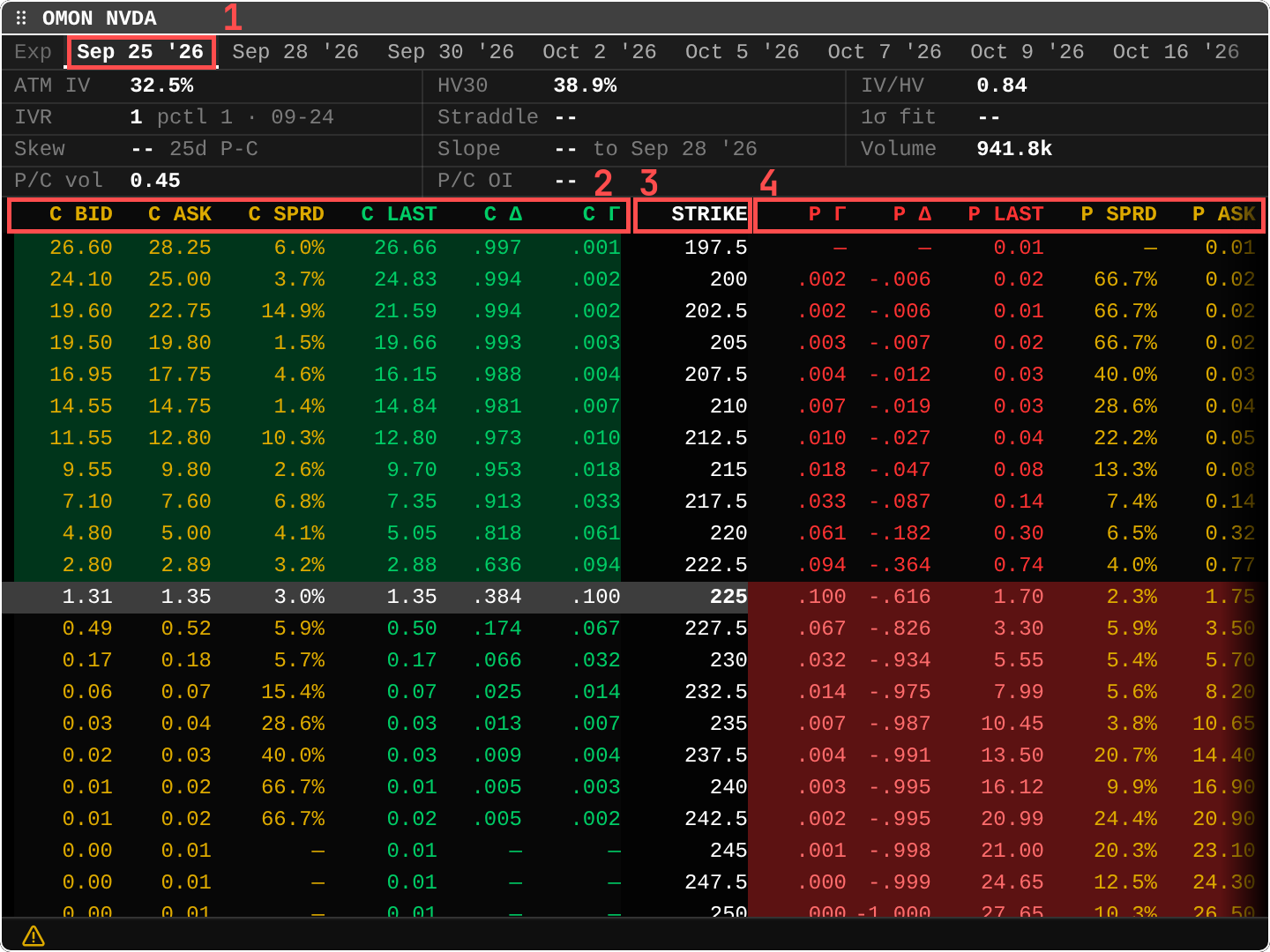
Illustrative snapshot. Look at how the page is laid out: calls on the left, puts on the right, the strike price in the middle. Shaded cells are options that would already be worth something if used today (next lesson: "in the money").
open ittype OMON NVDA in the command bar. OMON is the options chain, the menu of every option on one stock.
- Expiry tabs. Each tab is one deadline date. You pick one, and the table shows only options that expire then.
- Call side. Left half.
C BIDis the best price a buyer offers now;C ASKis the price a seller wants. You buy at the ask and sell at the bid. - Strike. The middle column. Each row is one fixed price.
- Put side. Right half, same idea for puts.
Read one row: strike 225, call ask 1.35. One contract costs about 1.35 x 100 = $135.
Practice and recap
Try it3 tasks
- In the screenshot, find strike 200. What is the call's ask? (It is 25.00, so one contract costs about $2,500.)
- Find strike 240. The call asks 0.02. Why is it so cheap? (The stock is near 225, so a call at 240 needs a big rise first.)
- Look at the shaded cells. On the call side they are the low strikes. Why? (A right to buy cheap is already worth something.)
Common mistakes3 mistakes
- Thinking one contract is one share. It is 100 shares.
- Thinking buying a call means you own the stock. You own a right, nothing more.
- Forgetting the clock. An option dies at expiry, a stock does not.
Check yourself3 questions
- What are you paying for when you pay a premium?
- A put gives you the right to do what?
- A stock option is quoted at 2.40. What does one contract cost?
Answers
- The right, with no duty, to buy or sell at the strike before expiry.
- Sell the underlying at the strike.
- 2.40 x 100 = $240.
Words in this lesson9 words
- option
- A contract giving the right, not the duty, to buy or sell at a fixed price before a deadline
- call
- The right to buy
- put
- The right to sell
- underlying
- The stock, ETF or index the option is about
- strike
- The fixed price in the contract
- expiry
- The last day the option exists
- premium
- The price of the option
- contract
- One standard option, covering 100 shares
- exercise
- Using the right
Educational material about reading market data, not investment advice.