Estimates, surprises and revisions (EE, EM)
EE sets analysts' consensus estimates next to the results actually reported, and EM tracks how that consensus is being revised.
- 4 min
- 3 questions
- Lesson 2 of 5
Why you would care
What is expected, and is that expectation rising or falling? A stock often moves more on changes in expectations than on results. When analysts raise next year's estimates week after week, the market notices before the next report. Knowing the consensus is also the only way to judge a result: "EPS of 2.22" means nothing until you know 2.00 was expected.
The idea from scratch
Estimates and the consensus
A sell-side analyst (chapter 01, Who is who on Wall Street) builds a model of a company and publishes estimates: EPS and revenue for the current quarter, the next quarter, this fiscal year and next.
The consensus is the average of all analysts' estimates for one period. The range (high to low) shows how much they disagree.
Surprise
On report day:
- Surprise = actual - consensus.
- Surprise % = surprise / consensus.
Companies often guide expectations a bit low, so small beats are common. The market cares more about the size of the beat, and above all about the guidance for next quarters (next lesson).
Revisions
An estimate revision is an analyst changing a number. Counting revisions over 7 or 30 days gives a feel for direction:
- Many up revisions: business is improving faster than expected.
- Many down revisions: expectations are being cut, often after a weak report or a warning.

See it in Gloom
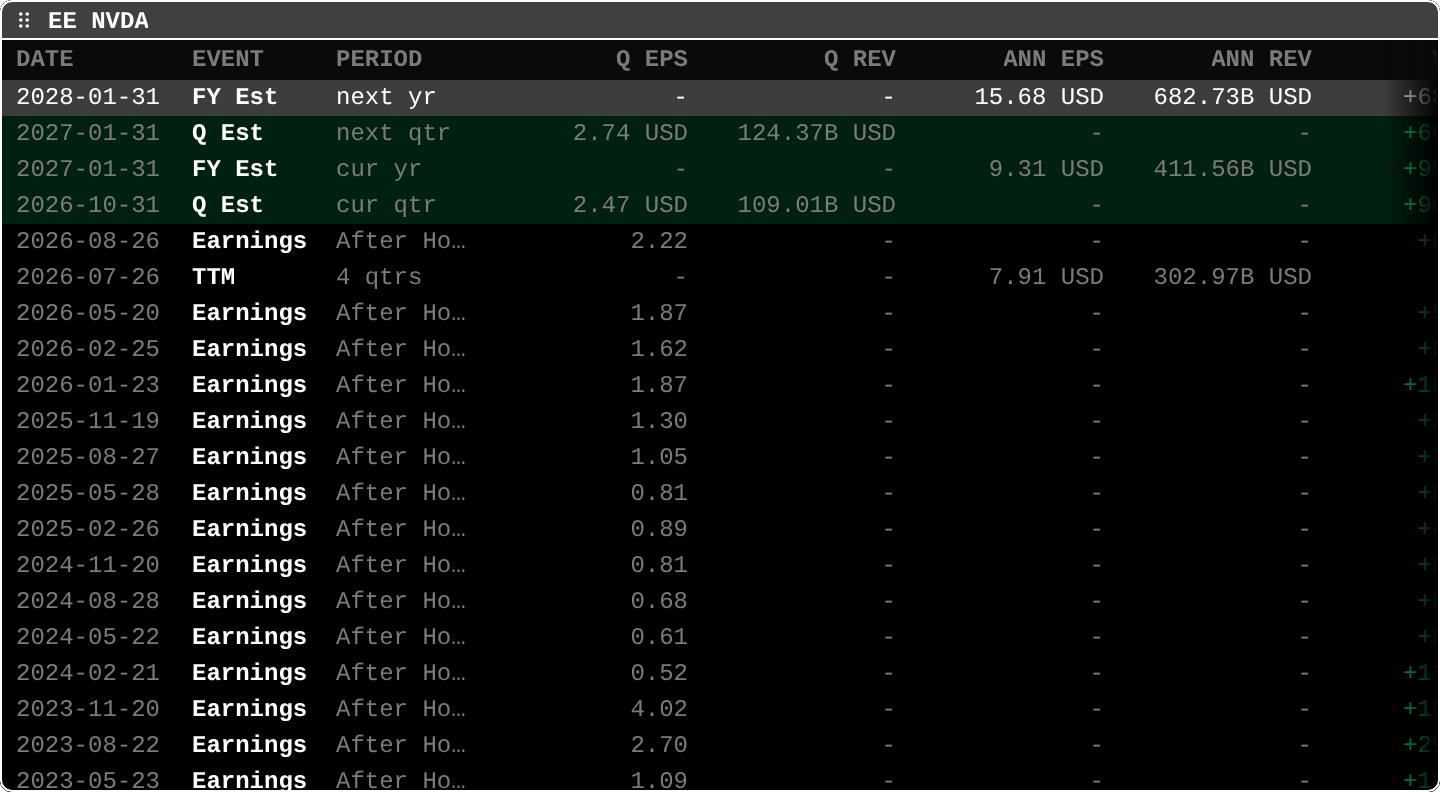
open ittype EE NVDA. Enter opens a row.
2026-10-31 Q Est cur qtr 2.47 USD 109.01B USD: the consensus for the current quarter (ending October 31): 2.47 dollars of EPS on 109.01 billion of revenue.2027-01-31 Q Est next qtr 2.74 USD: the quarter after.FY Est cur yr 9.31 USD 411.56B USDandnext yr 15.68 USD 682.73B USD: the fiscal years. Analysts expect EPS to jump about 68% next year.2026-08-26 Earnings After Ho… 2.22: the last report, after hours, with actual EPS of 2.22.TTM 4 qtrs 7.91 USD: the sum of the last four quarters' EPS.- Far right (cut off here): each report's surprise against the consensus.
EM MSFT (revisions, needs a free account) shows each period's consensus with its latest change, the high-low analyst range, the count of up and down revisions over 7 and 30 days, and tabs for Surprises and the company's Guidance.
Practice and recap
Try it3 tasks
- From the screenshot, how much EPS growth does the consensus expect from the current year to next year? (15.68 / 9.31 - 1 = about 68%.)
- A company reports 1.05 against a 1.10 consensus. Surprise %? (-0.05 / 1.10 = about -4.5%. A miss.)
- Why might a stock fall on a beat? (Weak guidance, or the beat was smaller than the "whisper" expectation.)
Common mistakes4 mistakes
- Comparing adjusted consensus EPS with GAAP EPS from the statements.
- Ignoring the range: a consensus of 2.00 with estimates from 1.50 to 2.50 is fragile.
- Reading one revision as a trend.
- Forgetting fiscal years: NVIDIA's fiscal 2027 ends in January 2027.
Check yourself3 questions
- What is the consensus?
- Actual 3.30, consensus 3.00. Surprise and surprise %?
- What does a rising number of down revisions suggest?
Answers
- The average of analysts' estimates for one period.
- +0.30, or +10%.
- Analysts are cutting expectations; the business may be weaker than thought.
Words in this lesson6 words
- estimate
- An analyst's forecast of a number, like next quarter's EPS.
- consensus
- The average of analysts' estimates.
- surprise
- Actual minus consensus.
- revision
- An analyst changing an estimate.
- adjusted EPS
- EPS that leaves out items like one-off charges; what analysts usually forecast.
- GAAP
- The official US accounting rules; GAAP EPS is the statement figure.
Educational material about reading market data, not investment advice.