Guidance (GUID, GUIDE)
Guidance is the company's own forecast, and GUID and GUIDE set it next to the consensus and track each guided number, its raises and cuts, and the actual result.
- 4 min
- 3 questions
- Lesson 3 of 5
Why you would care
What does the company itself expect? Many stocks move more on guidance than on the quarter just reported. "Beat and raise" (a beat plus higher guidance) is the best headline in earnings season; "beat but guided lower" can sink a stock. Guidance is also a promise you can check later: did management deliver what it guided?
The idea from scratch
Guidance is a forecast published by the company, usually in its earnings release and on the call. Common forms:
- A range: "revenue of 52 to 54 billion next quarter."
- A point or approximate number: "about 70% revenue growth next year."
- A qualitative statement: "we expect margins to improve."
What matters is the comparison:
| Situation | Typical reading |
|---|---|
| Guidance midpoint above the consensus | Good: management sees more than analysts did |
| Guidance below the consensus | Bad: expectations will be cut |
| Raise: higher than the company's own previous guidance | Business improving |
| Cut: lower than before | Business weakening |
| Withdrawn | Management cannot see clearly: uncertainty |
Companies are not required to give guidance. Many do because investors ask for it; some stop in uncertain times.

See it in Gloom
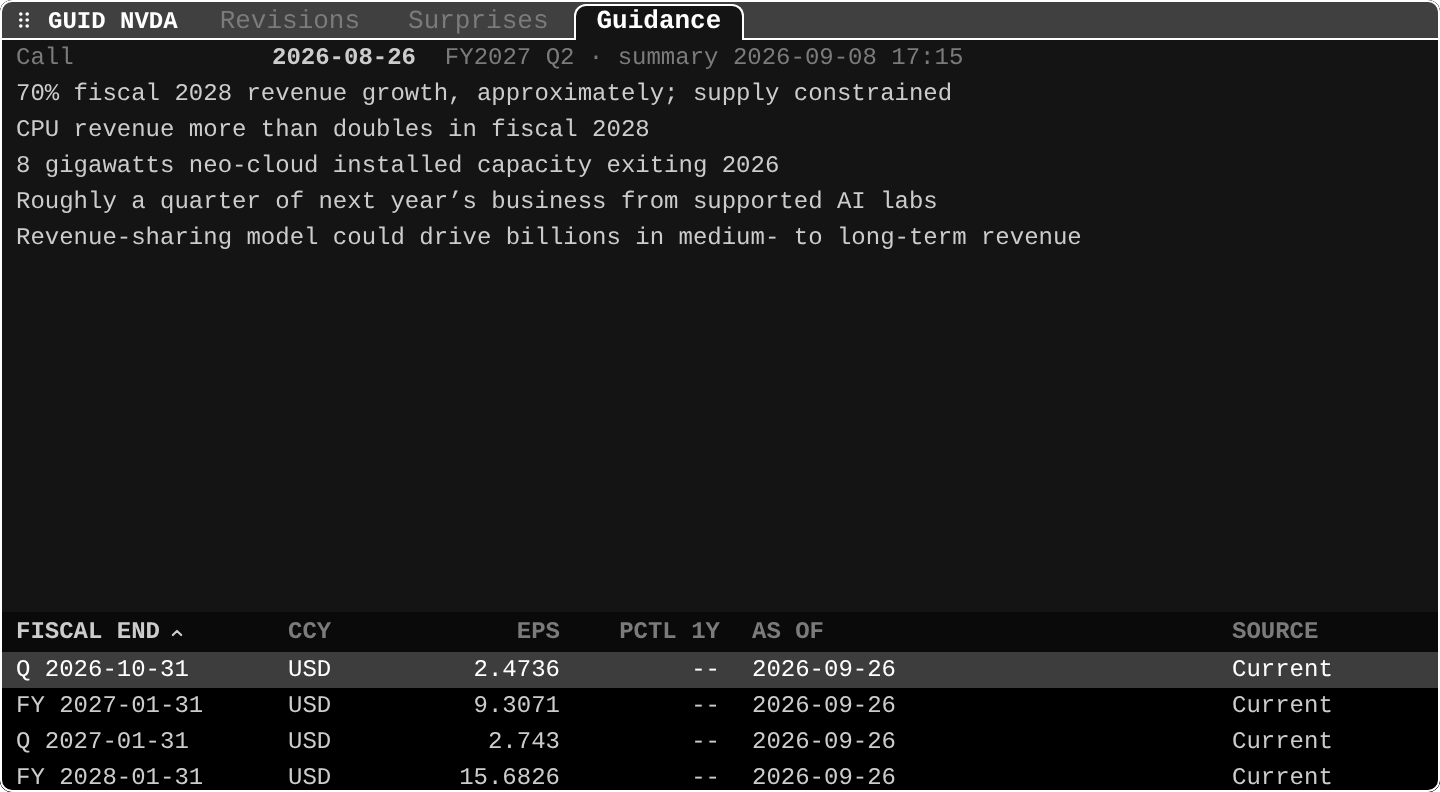
open ittype GUID NVDA. Tabs: Revisions, Surprises, Guidance. o opens the source.
Call 2026-08-26 FY2027 Q2 · summary 2026-09-08: the call the outlook comes from, and when it was summarized.- The outlook lines: "70% fiscal 2028 revenue growth, approximately; supply constrained", "CPU revenue more than doubles in fiscal 2028"... Each is a forecast in management's words, from the transcript.
- The table below: the consensus EPS for each fiscal period (
Q 2026-10-31 2.4736,FY 2028-01-31 15.6826), so you can hold the guidance against what analysts expect.

GUIDE NVDA turns guidance into a tracker: one row per guided metric and fiscal period, with the guide (≈ 70%), the action (raise, cut, reiterate, or "Not comparable" when there is no earlier guide to compare with), a Chart of the guide over time, a History of actuals against guidance, and the Evidence (the exact sentence and document). A raise reads green, a cut red, a withdrawal amber.
Practice and recap
Try it3 tasks
- In GUID, which line is a growth rate and which is a capacity number? ("70% fiscal 2028 revenue growth"; "8 gigawatts ... installed capacity".)
- Guidance for revenue: 10.0 to 10.4. Consensus: 10.5. Good or bad sign? (Below consensus: estimates will likely be cut.)
- Why does
GUIDEsay "Not comparable" for the first guide of a new year? (There is no earlier guidance for that period to compare with.)
Common mistakes4 mistakes
- Comparing guidance with last year instead of with the consensus.
- Reading the low end of a range as the forecast. The midpoint is the usual reference.
- Forgetting that conservative managers guide low on purpose.
- Treating qualitative guidance as a number.
Check yourself3 questions
- What is "beat and raise"?
- Guidance 20 to 22, consensus 20. Above or below?
- Where does
GUIDtake its outlook lines from?
Answers
- A result above consensus plus higher guidance for coming periods.
- Above: the midpoint, 21, is 5% over the consensus.
- From the latest earnings-call transcript.
Words in this lesson5 words
- guidance
- The company's own forecast for coming periods.
- guidance range / midpoint
- The low-to-high forecast / the middle of it.
- raise / cut / withdraw
- Guidance moved up / down / taken back.
- beat and raise
- A beat on results plus raised guidance.
- reiterate
- Confirm the previous guidance unchanged.
Educational material about reading market data, not investment advice.