Value, quality and GARP screens (EQS)
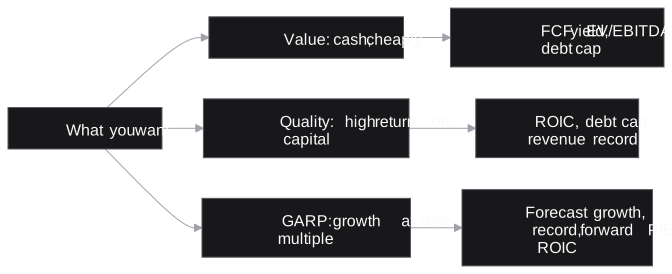
Three of the ready screens in EQS write three styles of stock picking as rules: Value looks for cash bought cheaply, Quality for businesses that earn a high return on their capital, and GARP for steady growth at a price the growth can carry.
- 5 min
- 3 questions
- Lesson 6 of 9
Why you would care
"Cheap", "good" and "growing" are the words investors use most, and each hides a choice. A ready screen writes the choice down as numbers, so you can see what each style looks for and where it can fool you.
The idea from scratch
Value. A company is cheap when you pay little for what it produces. FCF yield (free cash flow / market cap) is like an interest rate on the business. EV/EBITDA prices the whole business, debt included. A low price on a heavily indebted company is not cheap, since the lenders are paid first, so a value screen also caps net debt / EBITDA: roughly how many years of EBITDA would cover the debt, net of cash.
Quality. A good business earns a lot on the money put into it. ROIC (return on invested capital) is after-tax operating profit over the equity and debt invested. Quality screens add low debt and a record of growing revenue, so a high return is not a one-year spike.
GARP (growth at a reasonable price). A low P/E alone finds slow or shrinking companies, often cheap for a reason. Fast growth alone finds companies whose price already assumes the growth will last. GARP sits between the two: steady growth, at a multiple the growth can carry.
The PEG ratio weighs both at once: the P/E divided by the yearly earnings growth in percent.
Very fast growth rarely lasts, so GARP screens cap growth as well as floor it.
See it in Gloom
Open ittype EQS, go to the Ideas tab and open Value, Quality or GARP. From the shell: gloom fn EQS --preset value (or quality, garp).
| Idea | Rules | Ranked by |
|---|---|---|
| Value | FCF yield ≥ 6%, EV/EBITDA ≤ 10, net debt / EBITDA ≤ 3 | FCF yield, highest first |
| Quality | ROIC ≥ 15%, net debt / EBITDA ≤ 2, revenue CAGR 5Y ≥ 5%, FCF yield above 0 | ROIC, highest first |
| GARP | forward EPS growth 10% to 25%, EPS CAGR 3Y ≥ 10%, forward P/E ≤ 20, ROIC ≥ 10% | forward EPS growth, fastest first |
Every idea also keeps companies above 2B of market cap. Once open, an idea is an ordinary screen: change a threshold, add a rule, save it. The Ideas tab holds more: eight screens on classic scores (next lesson) and one on sector grades.
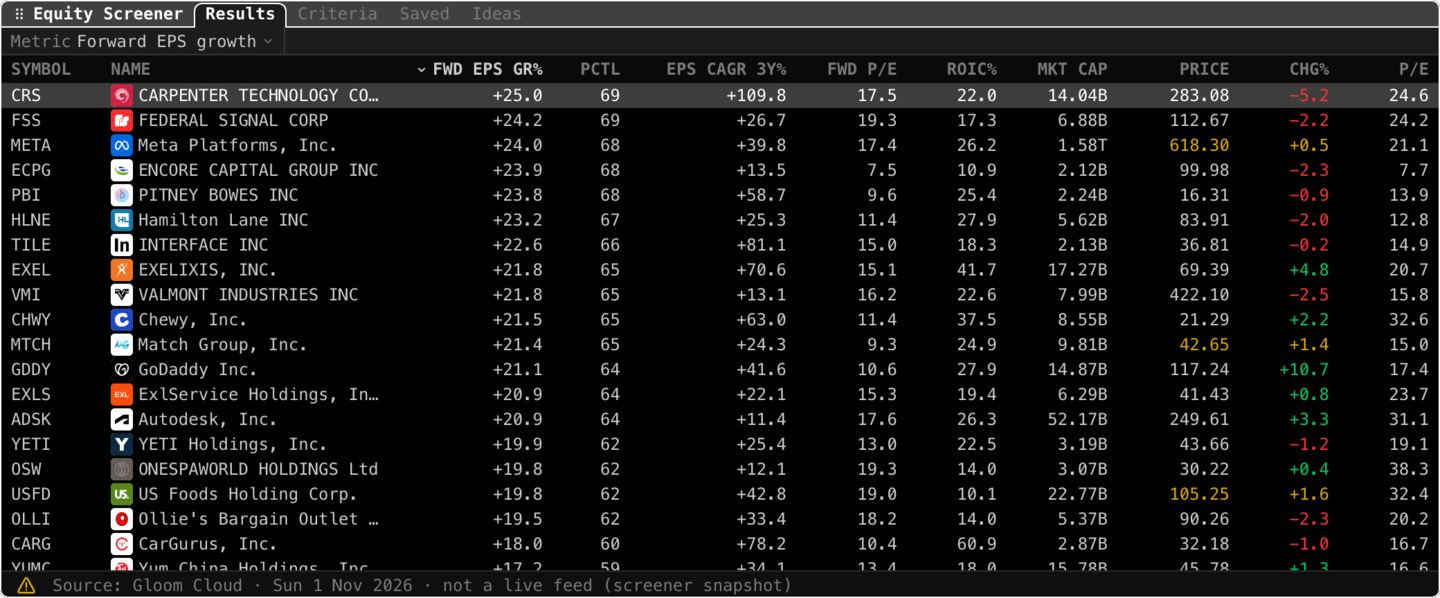
Metric Forward EPS growth: GARP ranks by the earnings growth analysts expect for the fiscal year in progress, asEEshows it.CRS +25.0: the top of the 10% to 25% range. Faster forecasts are left out.EPS CAGR 3Y%: the record, compounded over three years. META's+39.8means earnings grew about 40% a year.FWD P/E: the price over next year's expected earnings. META's17.4on+24.0growth gives a PEG of about 0.7.ROIC%: this rule keeps out companies whose earnings only grow because they are recovering from a loss.ECPG FWD P/E 7.5: the lowest multiple in view. A very low multiple is a question before it is a bargain.
Practice and recap
Try it3 tasks
- In the shot, CRS has a forward P/E of 17.5 and expected growth of 25.0%. Its PEG? (17.5 / 25, about 0.7.)
- A company has an FCF yield of 8% and net debt of 5 times EBITDA. Which Value rule removes it? (Net debt / EBITDA ≤ 3.)
- Why does the GARP idea cap forecast growth at 25%? (Very fast growth rarely lasts, and the price often assumes it will.)
Common mistakes4 mistakes
- Treating a forecast as a fact: forward growth is an estimate, and estimates move.
- Calling a low P/E cheap without asking why the market prices it low.
- Reading one strong year of ROIC as quality: the record matters.
- Forgetting the 2B floor: smaller companies never appear in an idea until you remove that rule.
Check yourself3 questions
- What does GARP stand for, and what does it look for?
- What does the PEG ratio combine?
- Why does the Value idea cap debt?
Answers
- Growth at a reasonable price: steady earnings growth, bought at a multiple the growth can carry.
- The P/E and the yearly earnings growth rate: P/E divided by growth in percent.
- A low price on a heavily indebted company is not cheap, because the lenders are paid first.
Words in this lesson7 words
- GARP
- Growth at a reasonable price.
- PEG ratio
- P/E divided by yearly earnings growth in percent.
- FCF yield
- Free cash flow divided by market cap.
- net debt / EBITDA
- Debt minus cash, over a year of EBITDA.
- ROIC
- After-tax operating profit over the equity and debt invested.
- CAGR
- Compound annual growth rate: the steady yearly rate from start to end.
- forward P/E
- Price over next year's expected earnings per share.
Educational material about reading market data, not investment advice.