Classic value and quality scores (EQS)
Four classic scores each turn the statements into one number: Piotroski's F-score (getting stronger?), Altman's Z (how far from distress?), the Graham number (the most a careful buyer pays) and the Magic Formula (good businesses at cheap prices).
- 5 min
- 2 questions
- Lesson 7 of 9
Why you would care
Ratios one at a time are hard to weigh: margins up, debt up, cash flow flat. Each score answers one question with one number: a filter, not a verdict.
The idea from scratch
Piotroski F-score (0 to 9): is the business getting stronger?
Nine yes-or-no tests of the latest fiscal year against the one before, one point each:
Profit
net income above zero; operating cash flow above zero; return on assets higher; cash flow above net income.
Funding
long-term debt (against assets) no higher; current ratio higher; no new shares.
Efficiency
gross margin wider; revenue per dollar of assets higher.
Piotroski used it to sort cheap stocks (low price to book) into improving and sinking; 8 or 9 is his high group.
Altman Z: how far from distress?
Edward Altman's 1968 formula weights five ratios that tended to fall before bankruptcies:
Z = 1.2 x working capital / assets + 1.4 x retained earnings / assets + 3.3 x EBIT / assets + 0.6 x market cap / liabilities + 1.0 x revenue / assets
Above 2.99 is his safe zone; below 1.81, distress. Banks, insurers and other financial companies read N/M: the formula was not built for their balance sheets.
The Graham number: the most a careful buyer pays
Benjamin Graham's defensive investor paid at most 15 times earnings and 1.5 times book; the limits multiply to 22.5:
Graham number = √(22.5 x EPS x book value per share)
A price below it is within his limits. Over a loss it reads N/M.
The Magic Formula: good businesses at cheap prices
Joel Greenblatt ranks companies on two numbers:
- Earnings yield = EBIT / enterprise value: profit per dollar paid for the whole business. High means cheap.
- Return on capital = EBIT / (working capital + net plant and equipment): profit on the money tied up to run it. High means good.
Rank every company on each, add the two ranks, rank the sums: 1 is best. Financials and utilities are left out.
See it in Gloom
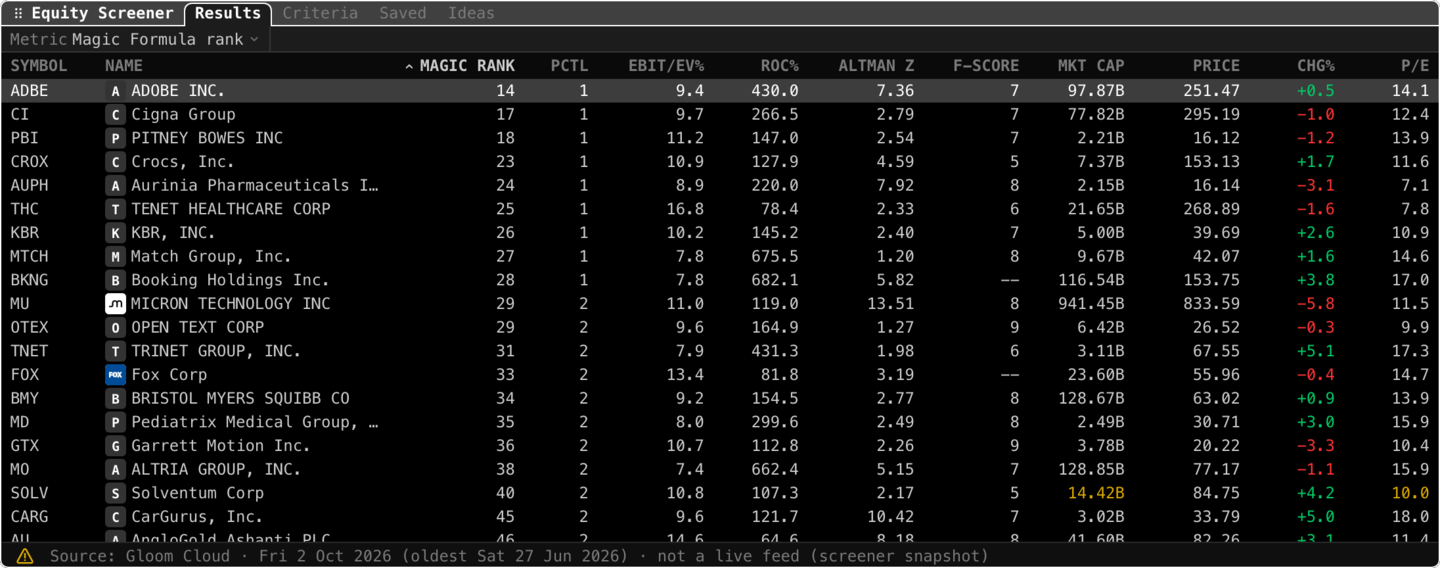
Open itEQS, then Ideas, or add a score as a criterion or column. Shell: gloom fn EQS --preset magic-formula.
ADBE 14 9.4 430.0: 14th; little plant or working capital, so a very high return on capital.MTCH 27 ... ALTMAN Z 1.20: high on the formula, under Altman's 1.81 line.--: not computed.
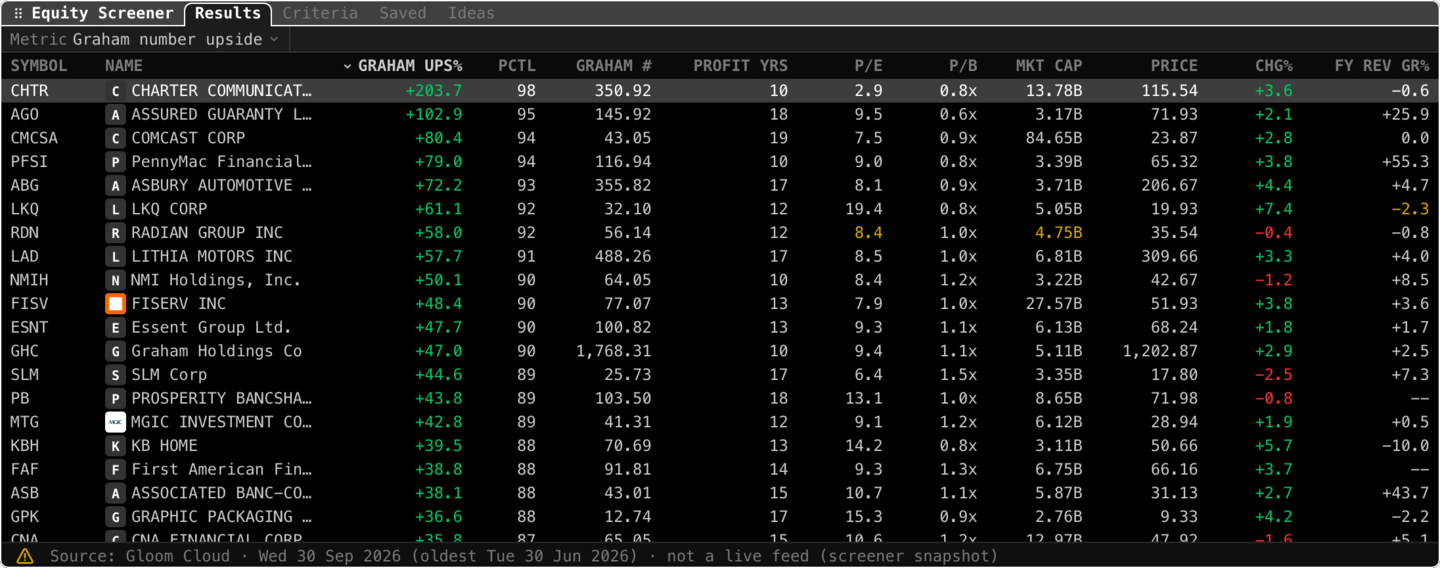
CMCSA +80.4 43.05 19: a Graham number of 43.05, 80.4% above the 23.87 price, after 19 profitable years.
The eight score screens in Ideas, each on companies above 2B of market cap:
| Idea | Keeps | First |
|---|---|---|
| Piotroski 8-9 | F-score ≥ 8, P/B ≤ 2 | highest score |
| Magic Formula top | rank ≤ 100 | best rank |
| Altman safe and cheap | Altman Z ≥ 3, P/E ≤ 15 | cheapest |
| Below the Graham number | price at or under it, 10+ profitable years | most upside |
| Below Lynch fair value | price at or under EPS x 5-year EPS growth (PEG 1), debt ≤ equity | most upside |
| Dividend growers | 5+ years of dividend growth, yield ≥ 2%, payout ≤ 75% | fastest dividend growth |
| RS leaders | RS rating ≥ 90 (top tenth on 1-year return), within 15% of the 52-week high | highest rating |
| Steady compounders | 10+ profitable years, 5+ years of revenue growth, ROIC ≥ 15% | longest revenue streak |
Practice and recap
Try it2 tasks
- EPS 2 and book value 18 a share. Graham number? (√810 ≈ 28.5.)
- In the first shot, which company has the highest Altman Z? (MU, 13.51.)
Common mistakes2 mistakes
- Treating a high F-score as cheap: it measures improvement, not price.
- Taking a price under the Graham number as a bargain without asking why.
Check yourself2 questions
- What does an F-score of 9 mean?
- Which two numbers does the Magic Formula rank on?
Answers
- All nine tests passed: profit, funding and efficiency all improved on the year before.
- Earnings yield and return on capital.
Words in this lesson4 words
- Piotroski F-score
- Nine tests of improving finances, 0 to 9.
- Altman Z-score
- A distress score: above 2.99 safe, below 1.81 distress.
- Graham number
- The most a defensive investor pays per share.
- Magic Formula
- A rank on earnings yield and return on capital together.
Educational material about reading market data, not investment advice.